Aevocam vs CameraFTP
- What is CameraFTP?
- How are Aevocam and CameraFTP similar?
- How are they different?
- Pricing models and examples
- What makes Aevocam better for some?
- A comparison made in good faith
What is CameraFTP?
CameraFTP has provided FTP-based video and timelapse photo cloud storage and viewing. Their business model is oriented around predictable, relatively low cost storage service.
CameraFTP is a division of DriveHQ , a more generalized cloud storage service that has operated since 2003.
CameraFTP has documented some cameras that are compatible with their service (and, by implication, ours), making their website a good resource for Aevocam camera setup. They have even put together some videos that walkthrough the configuration of some of those cameras.
We recognize CameraFTP as a fine competitor with what appears to be a solid service offering -- one that might be excellent for some organizations needs. But we think Aevocam will serve others' needs better.
How are Aevocam and CameraFTP similar?
On the surface Aevocam and CameraFTP seem to offer a very similar service. Both offer cloud-based image storage uploading primarily via FTP. Both offer schedule-based photo uploading for timelapse-style viewing. CameraFTP also offers video storage (which Aevocam does not).
Both services allow you to avoid vendor lock-in by keeping your camera vendors separate from your cloud storage. This enables you to have a fleet of cameras from any number of different vendors.
Both services offer relatively low entry rates that make it easy for organizations to get started.
Both services also offer some enterprise-level features. Most notably, the ability to have multiple users who can view and manage cameras and their settings.
How are they different?
The scheduled upload of snapshots via FTP is where the similarities end.
Fundamentally, CameraFTP is a storage service. A special application of DriveHQ's more generalized storage service, foremost, with content upload and viewing features. Meanwhile, Aevocam is foremost a long term condition monitoring service that uses image storage and viewing as a means to an end. This makes a world of difference.
Aevocam offers customizable retention policies . You might choose to upload 10 photos every day, but after they age to 6 months, trim photos from 6 months ago down to just 2 per day -- and then after 5 years, trim those photos down to one per week. By doing so, you can keep your costs from rising linearly. With CameraFTP, every photo lasts a fixed amount of months or years, and then they all get deleted.
Aevocam also offers lower cost "cold storage" for archiving your photos instead of deleting them (just in case).
Aevocam's player offers instant playback from any point in time. There's no waiting. No loading time. You can drag the slider representing the entire history to any point in time and the photos are there in an instant. Ready to zoom and pan. Ready to play forward or in reverse like a video. Or to step through one by one for very fast, precise investigation of changes at the finest level.
One of the more significant differences is in the realm of pricing. With CameraFTP, you choose a fixed setup with a certain number of cameras, upload rate per camera, image resolution, and retention period and you get a fixed price. Aevocam instead offers usage-based pricing with a fixed subscription rate and a generous allowance deducted from your usage fees. For many organizations just starting out, their costs stay within the allowance, keeping their cost fixed at the subscription fee for months or even years until they start generating more serious usage numbers. More on that in the next section.
In the near term, Aevocam, like CameraFTP, is focused on getting the basics of human-based condition monitoring solid and well understood by our clientele. But our sights are set on the next phase: using machine vision to help automate condition monitoring. We don't want to overpromise, so I'll keep this vague for now. The point being to emphasize our focus on long term condition monitoring. Not simply storage.
Pricing models and examples
It can be a little tricky to compare CameraFTP's and Aevocam's pricing models. I'm going to start by conceding that when you strip away all the complexity and you maximize your use of a CameraFTP plan, the cost per megabyte of storage is, bluntly speaking, cheaper for CameraFTP. Hands down. But there are many things that can tip the total cost of ownership (TCO) in favor of Aevocam's usage-based model over CameraFTP's fixed-rate pricing. The next session discusses some of this further.
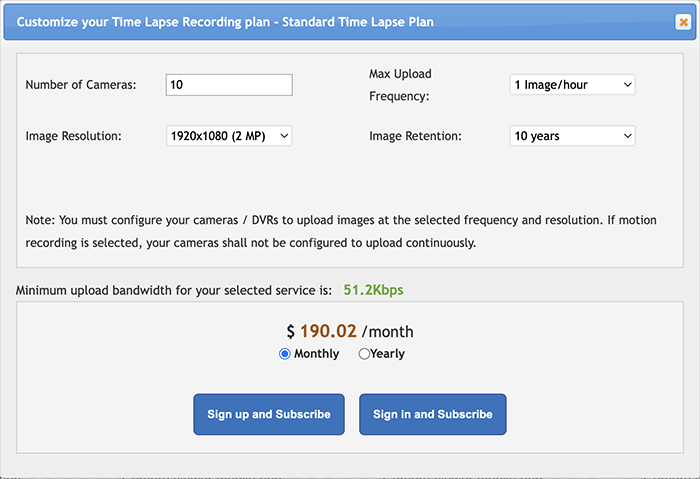
Your best resource for calculating CameraFTP's costs for the closest equivalent to Aevocam is their time lapse pricing page . I'll use examples from that page as of 4/4/2026 below.
Your best resource for calculating our costs is our usage cost calculator. You can interact with the examples included below. Although our calculator uses the current base rates, the narrative text is based on our published rates from 4/4/2026.
Let's start with an apples-to-apples comparison. In this example we have 10 cameras submitting 1080p photos, and a retention of 10 years. We don't expect Aevocam users to typically cut them off like that, but this makes the comparison clearer. One big difference is that for CameraFTP, you're assumed to be uploading one photo every hour. We'll go with that same rate here, though that's an unlikely use pattern. Here's how the prices look:
Storage rate × stored megapixels at the target month (after culling).
This is not the cumulative cost. Instead it is what the storage bill will be at the end of the target month.
This naturally rises linearly with each passing month because the number of photos and hence total megapixels stored goes up by the same amount each month.
Note that culling will affect this calculation.
CameraFTP clocks in at $190/mo. In the first year, Aevocam's bills are cheaper. They increase over time as storage usage grows. By the time you get to year 10 and the monthly bill levels off, your monthly cost is about 10x more. This is the cleanest all-things-equal comparison I can make. If all that matters is raw storage cost, CameraFTP is simply cheaper. To be sure, this calculation assumes that you make 100% use of this tier of service by unfailingly filling every last time slot of every day for 10 years. You're on their schedule, instead of your own. Do you really need 2am photos of your property, for example? See the next section for discussion of the practical differences.
Let's compare that to a more realistic use case for Aevocam though. 10 cameras all uploading 3 photos per day at specific times. After photos age 6 months, they get culled down to 1 per day. Everything else is the same:
Storage rate × stored megapixels at the target month (after culling).
This is not the cumulative cost. Instead it is what the storage bill will be at the end of the target month.
This naturally rises linearly with each passing month because the number of photos and hence total megapixels stored goes up by the same amount each month.
Note that culling will affect this calculation.
Bottom line now is $50/mo for 4 years before usage fees start climbing beyond the allowance. By year 10 the monthly costs are about $94, which is less than half the cost for CameraFTP's plan. In this scenario, you're keeping that one photo per day forever. In that case, we only finally surpass that $190/mo around year 24.
In practice, your retention plan can go further by culling down to one photo per week or even per month if you want. Making keeping long and growing visual histories feel like flat rates when looking out over decades or even centuries.
What makes Aevocam better for some?
As you've seen above, CameraFTP's pound-for-pound storage costs are undoubtedly cheaper. But Aevocam isn't simply a time lapse photography service. We provide sophisticated camera feed configurations that make it much more practical over a long term to detect and quantify changes in the condition of fixed properties. We provide enterprise-level tools to manage fleets of potentially thousands of cameras with however many people you assign access to review and manage feeds.
We aren't just storing your uploaded photos. We are also storing a lot of metadata about each photo. Plus "sprite sheets" we generate that enable loading and viewing of photos at any point in time nearly instantly.
We have a clear path to integrating machine vision algorithms into our pipeline to help automate meaningful change and condition detection.
We also offer a REST API for you or third parties to access some or all your data to do further analysis beyond what we provide. Access is tightly controlled through short-lived scoped access leases to ensure your data remains private and secure.
For some users, this is a summary way of comparing the value propositions of the the two services:
| CameraFTP | Aevocam |
|---|---|
| Pay for capacity | Pay for signal |
| Fixed schedule | Flexible capture |
| Optimize utilization | Optimize relevance |
| Flat pricing | Adaptive pricing |
In short, we are offering long term condition monitoring. Not simply bulk image storage.
A comparison made in good faith
The above reflects the best understandings and opinions of the founders of Aevocam. All statements are made in good faith with no intent to deceive. But we recognize the potential for making mistakes. We invite anyone with relevant knowledge to contact us to offer corrections.